Decorating for Your Climate: A Region-by-Region Guide
Decorating for your climate, region by region: materials that last, renter fixes, patio timing and budget kits for humid, cold, dry and coastal homes.
Under $100 · Renter-safe · Easy · 1 weekend per kitUpdated
In this post
Decorating for your climate means picking rugs, fabrics, furniture and window treatments that can handle the air you actually live in. A jute rug that lasts years in Denver can mildew in a Houston bathroom. A wicker chair that's fine on a Phoenix porch can crack inside a heated Chicago apartment in January.
This guide splits the US into seven decorating regions. For each one you'll get the materials that hold up, the ones to skip, cheap renter fixes, and when to set out (and pack away) the patio decor. Every climate and safety fact comes from a government agency, a university extension service or a safety group, and each region has a budget kit priced as of October 2026.
Renting? Everything here is reversible. For the rest of your rental, from walls to lighting, see our renter decorating guide.
Step 1: Find Your Climate Zone in Two Minutes
You don't need to guess. The US Department of Energy publishes a guide to climate regions by county with a table listing every US county.
Here's how the system works, according to that DOE guide:
- The International Energy Conservation Code (IECC) map splits the country into eight temperature-based zones, numbered 1 (hottest) to 8 (Alaska's subarctic).
- Each zone gets a moisture letter: A for moist, B for dry, C for marine. That allows up to 24 combinations.
- Zone boundaries follow county lines, so your county name is all you need.
- DOE's Building America program groups those zones into simpler regions: hot-humid, mixed-humid, hot-dry, mixed-dry, marine, cold, very cold and subarctic.
What the regions mean for your decor
| DOE region | IECC zones | What DOE's definition says | What it means indoors |
|---|---|---|---|
| Hot-humid | 2A and 3A below the "warm-humid" line (plus zone 1) | More than 20 in. of rain a year and long hours of muggy warm-season air | Mold, mildew, swelling wood |
| Mixed-humid | 4A and 3A above that line | More than 20 in. of rain, winter monthly averages below 45°F | Humid summers, dry heated winters |
| Hot-dry | 3B (and dry parts of 2) | Less than 20 in. of rain, monthly averages stay above 45°F | Sun fade, dry wood, heat |
| Mixed-dry | 4B | Less than 20 in. of rain, cold winter months | Dry air year-round |
| Marine | All "C" counties | Mild winters, warmest month under 72°F, a dry summer and a wet cold season | Damp winters, condensation |
| Cold / very cold | 5–6 / 7 | 5,400–9,000 / 9,000–12,600 heating degree days | Drafts, dry heated air, long dark winters |
Look up your county, note your region, then jump to the section below that matches. If you sit on a border, read both.
Code editions update county assignments from time to time, so your local building department has the final word on code questions. For decorating, the DOE table is plenty.
The Rules That Apply Everywhere
A few facts hold no matter where you live. Learn these once and every region below makes more sense.
Humidity: the 30–50% target
EPA says to keep indoor relative humidity below 60%, ideally between 30% and 50%. EPA also says to dry water-damaged areas and items within 24–48 hours to prevent mold, and to act on condensation by drying the surface and reducing the moisture source.
A digital hygrometer costs about $8–$15 and it's the cheapest way to stop guessing. It tells you whether you need to dry the air (South, Gulf, Pacific NW) or add moisture (heated winters, desert, mountains).
Wood moves with the air
Purdue Extension explains that wood swells when the air is humid and shrinks when it's dry. Finishes slow that movement but generally don't stop it. In a heated house with no humidification, Purdue says winter humidity "can drop to 20 percent or less," and after a winter of heating, "cracks can develop in wood floors, and furniture joints can open."
In a hot, humid summer (80°F and 80% humidity), wood moves toward 15.7% moisture content. That's why a thrifted dresser can stick in July and wobble in February. Our guide to protecting wood furniture from dry winter air goes deeper.
Fans and window coverings
DOE's Energy Saver guide and its fans page give the basic moves:
- Ceiling fans: counterclockwise in summer for a wind-chill effect, which lets you raise the thermostat about 4°F with no loss of comfort. ENERGY STAR says to run them clockwise on low in winter. Turn fans off when you leave the room.
- Winter windows: open drapes and shades on south-facing windows during the day, then close them at night to cut the chill from cold glass.
- Summer windows: keep coverings closed during the day, close draperies on windows in direct sun, and choose medium-colored draperies with white plastic backings to reduce heat gain.
- Don't block heat: keep registers, baseboard heaters and radiators clear of furniture, carpeting and drapes.
For insulation, a DOE fact sheet on Oak Ridge National Laboratory tests reports that cellular shades "saved up to 20% on heating energy and up to 15% on total energy from heating and cooling" compared with no shades, while vinyl or metal blinds "do not provide much insulation." We compare the options in thermal curtains vs. cellular shades.
Fire safety for cozy decor
The US Fire Administration (USFA) says to keep candles at least 12 inches from anything that burns, blow them out when you leave the room or go to bed, and consider battery-operated flameless candles. For heaters, keep anything that can burn at least 3 feet away, turn space heaters off when you leave the room or go to bed, and plug them directly into a wall outlet, never an extension cord or power strip.
Hot-Humid South and Southeast
This is DOE's hot-humid region: much of Texas, Louisiana, Mississippi, Alabama, Georgia, the Carolinas' coastal plain and Florida. DOE defines it by more than 20 inches of rain a year plus long stretches of high wet-bulb temperature in the warm months. Indoors, that means damp closets, musty rugs and swelling wood.
Materials that work
- Washable cotton, linen and polyester slipcovers you can throw in the machine.
- Flat-weave cotton or synthetic rugs in bathrooms, laundry rooms and entries.
- Sealed or painted wood, metal, glass and ceramic decor.
- Satin or semi-gloss paint in baths if you're allowed to paint, because it wipes clean more easily than flat.
Materials to skip or limit
- Jute, sisal and seagrass rugs in damp rooms. EPA notes that moldy porous materials such as carpet may need to be thrown out, and mold can hide under carpets and pads. Natural fibers are fine in a dry, air-conditioned living room, not by the shower.
- Unsealed raw wood in bathrooms and closets.
- Leather, suede and stored natural-fiber baskets in closed-up rooms without airflow.
Cheap renter fixes
- Put a hygrometer in the bedroom and one near the bathroom.
- Set moisture-absorber tubs in closets and under the sink. Dollar Tree sells single tubs (most items $1.25, some higher price points).
- Run the bathroom fan during and after showers, as EPA and UF/IFAS advise.
- Leave closet doors cracked and pull furniture a few inches off exterior walls so air can move.
- Hang a washable polyester shower liner and wash it with towels.
Our humid apartment mold-proof decor guide has a full room-by-room plan.
Seasonal timing
NOAA's Climate.gov explains that the last spring freeze arrives earlier the farther south and lower in elevation you go, so patio season here starts early, often in March. The challenge is summer: hot, muggy months when cushions left outside stay damp. Bring them in or store them in a deck box between uses.
Florida, the Gulf and the Atlantic Coast
Coastal homes have two extra problems on top of humidity: salt and storms.
Salt air and metal
UF/IFAS Extension says moisture, oxygen and salt "all contribute to the corrosion process," and "in coastal areas where moisture is saline or salty, corrosion can occur readily." Its corrosion guide adds:
- When aluminum meets salty moisture, it pits. That's what makes aluminum sliding-door tracks hard to slide.
- Mixing metals speeds corrosion. UF's example: joining aluminum and brass "would readily produce corrosion in the aluminum when moisture is present." Match your hooks, screws and fasteners to the furniture.
- Protect aluminum outdoor furniture with a coat of wax, or paint it. Rinse salt off well.
Materials that work
- Resin and plastic (HDPE) outdoor furniture, which won't rust.
- Powder-coated or waxed aluminum, rinsed regularly.
- Polypropylene outdoor rugs that dry fast and hose off.
- Outdoor-rated, quick-dry cushions you can store.
Materials to skip
- Untreated steel and wrought iron outdoors.
- Indoor rattan, wicker and cotton cushions on an open porch or balcony.
- Mixed-metal hardware, such as brass hooks on an aluminum railing.
See our salt-air balcony decor guide for a full shopping list.
Hurricane season and your patio
Ready.gov lists the Atlantic hurricane season as June 1 to November 30, and the National Weather Service says to prepare before the season begins on June 1. FEMA's hurricane advice includes clearing drains and gutters and bringing in outside furniture.
For decor, that means:
- Pick foldable, stackable or lightweight pieces you can move in minutes.
- Write a clear-out list: planters, lanterns, wind chimes, flags, string lights, rugs and cushions.
- Keep a bin or deck box ready for the small stuff.
- Use battery lanterns instead of candles for storm nights. USFA advises flashlights, not candles, during power outages.
Our hurricane-ready patio decor guide turns this into a checklist.
Seasonal timing
Patio season runs nearly all year. The real off-season for outdoor decor is hurricane season, especially late summer and fall.
That's when portable, storable pieces earn their keep. UF/IFAS also says indoor humidity in Florida homes "should generally remain around 55% or lower," so keep the hygrometer handy indoors too.
Northeast and Midwest: Cold Winters, Dry Indoor Air
DOE's cold region (IECC zones 5 and 6) gets 5,400 to 9,000 heating degree days a year, and very cold zone 7 gets 9,000 to 12,600. Parts of the Mid-Atlantic and lower Midwest fall in mixed-humid zone 4A, with humid summers and cold winters. Indoors, you're fighting drafts, dry heated air and short days.
Materials that work
- Wool and wool-blend rugs on cold floors, or a thick rug pad under a flat-weave.
- Lined or thermal curtains that hang wider than the frame and reach the sill or floor.
- Flannel, fleece and knit throws you can layer.
- Washable boot trays and indoor-outdoor mats for salt and slush at the door.
Materials to watch
- Solid wood and veneer near radiators and vents. Purdue's warning about cracked floors and open joints after a heating season applies here.
- Terra-cotta and glazed ceramic planters left outside. Water in the clay can freeze and crack them, so bring them in or store them dry.
Cheap renter fixes
- A fabric draft stopper at the entry door and removable rope caulk in window gaps. DOE says sealing air leaks can save 10–20% on heating and cooling bills.
- Lined curtains on tension rods or no-drill brackets.
- Ceiling fan clockwise on low.
- Furniture pulled 6–12 inches off baseboard heaters.
- A small humidifier, used with a hygrometer so you stay under 50%. EPA warns that condensation on windows is a sign of too much moisture.
Our step-by-step guide to keeping your apartment warm in winter covers each fix with removal notes.
Light for long, gray winters
The National Institute of Mental Health (NIMH) says seasonal affective disorder (SAD) "is more common in people living farther north, where there are shorter daylight hours in the winter," and names New England and Alaska as examples. For decor, think mirrors opposite windows, pale walls, sheer curtains by day and layered warm lamps at night.
Some people add a light box to a bright corner. Know what it is first: NIMH describes light therapy with a 10,000-lux box as a treatment for SAD, and notes that people with certain eye conditions or on certain medications may need alternatives or medical supervision.
Talk to a clinician before you buy one for that purpose. Our guide to brightening a gray winter apartment sticks to lamps, mirrors and color.
Seasonal timing
Climate.gov notes that the last spring freeze comes later the farther north and higher you go. In much of the northern US, frost-tender planters and patio cushions go out in late spring, often around Memorial Day (May 31, 2027). Check your local date on the Climate.gov map before you plant.
Desert Southwest
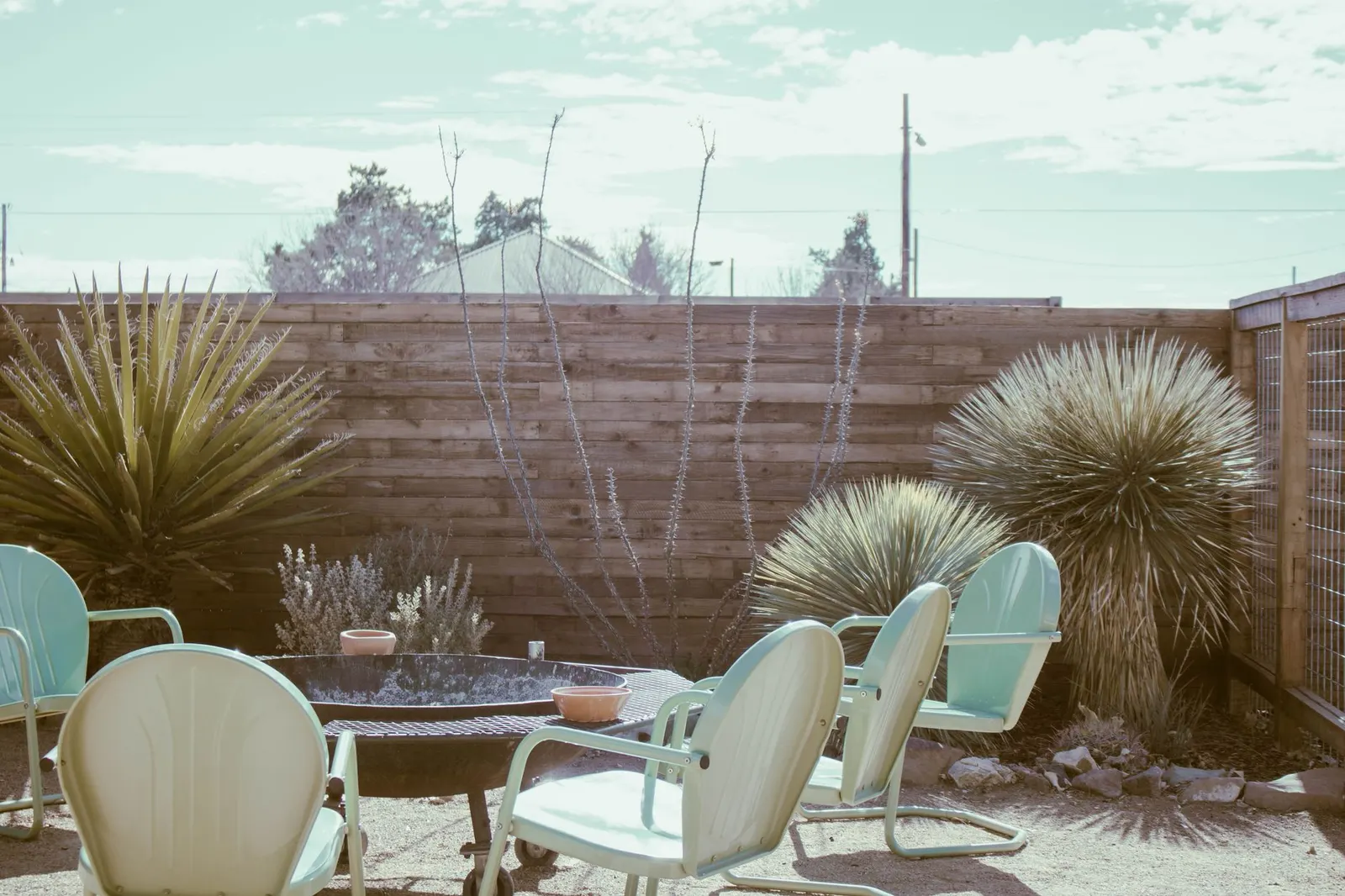
This is DOE's hot-dry region: southern Arizona, Las Vegas, parts of New Mexico and West Texas, and California's low deserts. Less than 20 inches of rain falls each year, and monthly averages stay above 45°F. Indoors, the enemies are sun, heat and very dry air.
Sun and fading
Strong desert sun fades fabrics and dries out wood. DOE's window advice is your toolkit:
- Apply sun-control or reflective film on east- and west-facing windows to reduce solar heat gain.
- Close draperies on windows in direct sun during summer days.
- Use medium-colored, white-backed draperies to cut heat gain.
- Add awnings on south- and west-facing windows if your lease or HOA allows.
Materials that work
- Light-colored, solution-dyed or fade-resistant fabrics in sunny rooms.
- Breathable cotton and linen for bedding and slipcovers.
- Terra-cotta, stone and ceramic decor that shrugs off sun.
- Wood kept out of direct sun and away from vents, since dry air pulls moisture out of it.
Materials to watch
- Dark upholstery in a west-facing room. Rotate cushions and rugs every few months so they fade evenly.
- Rattan and thin wood veneers in direct sun and dry air.
- Bare metal patio chairs in full sun, which get too hot to touch. Add cushions and shade.
Evaporative coolers and decor
The University of Arizona Cooperative Extension says evaporative cooling systems are "commonly used" in southern Arizona's semi-arid climate, along with outdoor misters. A swamp cooler adds moisture to the air, which is easier on wood.
Coolers work by evaporation, so they cool less in humid weather, such as during the summer monsoon. That's when some households switch to AC and the air gets drier again. Keep your hygrometer out year-round.
Our desert sun and fade-proof decor guide has a full room plan, including desert living room ideas.
Seasonal timing
Patio season is flipped. Fall, winter and spring are prime time outdoors. Mid-summer is the indoor season: store fabric cushions out of the sun and save the outdoor string lights for October.
Pacific Northwest
Coastal Washington and Oregon are in DOE's marine region (zone 4C). DOE defines marine climates by mild winters, a warmest month under 72°F, a dry summer, and a cold season where the wettest month gets at least three times the rain of the driest month. Indoors, think damp winters, foggy windows and long, dim days.
Materials that work
- Washable entry rugs for mud and rain.
- Mildew-resistant polyester shower curtains and quick-dry bath mats.
- Wool throws and blankets, which stay warm when the air is damp.
- Sheer or light-filtering curtains to let in every bit of daylight.
Materials to skip
- Natural-fiber baskets, rugs and cushions stored in damp basements, garages or storage units. EPA notes porous materials can be hard to save once they mold.
- Heavy, dark drapes that block what little winter sun you get.
Cheap renter fixes
- Wipe condensation off windows each morning. EPA says to dry the surface quickly and reduce the moisture source.
- Move furniture a few inches off cold exterior walls so air can circulate.
- Use moisture absorbers in closets and run the bath fan during and after showers.
- Open south-facing curtains on any sunny day and close them at night, as DOE advises.
The NIMH note on SAD applies here too: it's more common farther north. Mirrors, pale paint and layered lamps help a room feel brighter.
A light box is a treatment, so ask a clinician first. More ideas are in our gray winter apartment guide.
Seasonal timing
The dry summer is the real patio season, typically July through September. From fall through spring, choose covered spots, quick-dry cushions and outdoor-rated lights and cords for holiday decor.
California: Coast, Inland and Wildfire Smoke
California splits in two. The coast is mostly marine (zones 3C and 4C), while the Central Valley and inland areas are hot-dry or mixed-dry, according to DOE's county table.
The coast
NOAA explains that Southern California's early-summer marine layer is so persistent that people call it "May Gray" or "June Gloom," and that the West Coast marine layer can persist for days or weeks. Expect gray mornings and cool evenings even when the calendar says summer. Keep a basket of throws by the patio door.
Near the beach, salt air brings the same corrosion issues as Florida. UF/IFAS's research is Florida-based, but the chemistry is the same: wax or paint aluminum, rinse salt off and don't mix metals.
Inland valleys
Hot, dry summers call for desert tactics. Close drapes on sunny summer days, add film to east and west windows, and run ceiling fans counterclockwise, per DOE.
Wildfire smoke: make one clean room
Smoke can drift hundreds of miles, so this section is for anyone in the West and beyond. EPA's wildfire guidance says to:
- Pick a clean room that fits everyone, ideally with an attached bathroom. Close windows and doors.
- Filter the air. Choose a high-efficiency HVAC filter, such as MERV 13, if your system can take it.
- Don't add smoke indoors. Avoid burning candles or incense, frying or broiling food, spraying aerosols, and vacuuming unless your vacuum has a HEPA filter.
That last point matters for decor. On smoke days, the candle styling goes away. Battery-powered flameless candles keep the glow.
The DIY box-fan air cleaner
EPA's research on DIY air cleaners recommends:
- A MERV 13 filter strapped to a box fan made in 2012 or later with a UL or ETL safety mark.
- A cardboard shroud, which EPA found increases the clean air delivery rate by 40%.
- No extension cord.
- Keeping spare filters on hand and changing the filter when it starts to look dirty or smell like smoke.
Our wildfire smoke-ready home guide shows how to set one up so it doesn't look like a science project.
Patio decor in fire country
NFPA and IBHS recommend keeping the first 0 to 5 feet around a building, the "immediate zone," clear of combustible materials. They also recommend keeping building corners clear, keeping gutters clean, and using noncombustible mulch such as rock. As a practical step, when fire weather is forecast, move cushions, doormats, wicker, dried wreaths and fake-grass mats away from the walls and indoors.
Seasonal timing
Coastal patio season is nearly year-round, though often gray in May and June. Inland, spring and fall are best. Keep outdoor decor easy to clear in late summer and fall, when smoke and fire weather are a bigger concern.
Mountain West: High Altitude, Dry Air, Big Sun
Denver, Salt Lake City, Boise, Albuquerque's higher areas and mountain towns fall in DOE's cold, very cold or mixed-dry regions (B zones are dry). The decor challenges are UV, dry air and late frost.
UV and altitude
EPA's UV Index guide says UV "increases about 2% for every 1,000-foot increase in elevation," and snow may reflect as much as 80% of UV. By that rate, a city at 5,000 feet gets roughly 10% more UV than sea level, and a snowy yard bounces more of it toward your south-facing windows.
Materials that work
- Solution-dyed or UV-resistant fabrics on sunny sofas and chairs.
- Window film on sunny exposures, per DOE's advice for east and west windows.
- Wool rugs for warmth on cold floors.
- Art and photos hung out of direct sun, or framed behind UV-filtering glass.
Materials to watch
- Wood furniture, frames and instruments in dry, heated air. Purdue's research on shrinking wood applies, so humidify gently toward EPA's 30–50% band.
- Bright cotton prints in south-facing windows, which can fade over a sunny, snowy winter.
Heating and fire safety
Everything in the cold section applies: fan clockwise on low, south curtains open by day and closed at night, cellular shades or lined curtains, and the 3-foot heater rule.
Seasonal timing
Patio season usually starts in late May and runs through early fall. Store ceramic planters before the first hard freeze and bring cushions in when snow is forecast.
Patio Season by Region at a Glance
Use this table to plan when to buy, set out and store outdoor decor. Dates vary by city, so check Climate.gov's last-freeze map for your area.
| Region | Best patio window | Main watch-outs | Pack-away trigger |
|---|---|---|---|
| Hot-humid South | Early spring and fall | Muggy summers, mildew on cushions | Store cushions between uses in summer |
| Florida, Gulf and Atlantic coast | Nearly year-round | Salt corrosion; hurricane season June 1–Nov 30 | Any storm forecast |
| Northeast and Midwest | Late May to September | Late frost farther north and higher | First hard freeze in fall |
| Desert Southwest | October to April | Extreme summer heat and sun fade | Early summer |
| Pacific Northwest | July to September (dry summer) | Wet fall, winter and spring | Fall rains begin |
| California coast | Nearly year-round | May Gray and June Gloom; salt air | Fire weather or smoke |
| California inland | Spring and fall | Summer heat; late-summer and fall smoke | Fire weather or smoke |
| Mountain West | Late May to early fall | Late frost, high UV | Snow forecast or first hard freeze |
Your Renter Climate Kit, Priced by Region
Prices are approximate as of October 2026. Each kit is a starting point for one or two rooms, and every item comes out with no damage.
Start with the kit for your region, then borrow from the others as needed. A humid Midwest summer may need the humid kit in July and the cold kit in January.
Hot-humid and damp regions
Budget breakdown: Hot-humid and damp-climate kit (South, Gulf, Pacific NW)
$36–$85
| Item | Price range | Where to buy |
|---|---|---|
| Digital indoor hygrometer (humidity monitor) | $8–$15 | Walmart, Target, Amazon |
| Moisture-absorber tubs or hanging bags (multi-pack, for closets) | $8–$20 | Walmart, Home Depot, Dollar Tree (single tubs, most items $1.25) |
| Washable polyester shower curtain liner | $5–$15 | Target, Walmart, IKEA |
| Washable flat-weave or cotton bath and entry rugs (two) | $15–$35 | IKEA, Target, Walmart |
| Small portable dehumidifier for one damp room(optional)Compact units for closets and small baths; whole-room models cost more | $40–$70 | Walmart, Home Depot, Amazon |
| Total (without optional) | $36–$85 |
Prices are approximate as of October 2026 and vary by store and region. Prices are approximate as of October 2026 and vary by store, size and region. Optional items are marked.
Cold and dry-winter regions
Budget breakdown: Cold and dry-winter kit (Northeast, Midwest, Mountain West)
$44–$80
| Item | Price range | Where to buy |
|---|---|---|
| Digital indoor hygrometer | $8–$15 | Walmart, Target, Amazon |
| Fabric draft stopper for one door (DIY or ready-made) | $5–$15 | Thrift fabric; Walmart, Amazon |
| Removable rope caulk for window gaps | $6–$10 | Home Depot, Lowe's |
| Thermal or lined curtain panels (pair, one window) | $25–$40 | Walmart, Target, IKEA, Amazon |
| Small cool-mist humidifier for one room(optional) | $25–$45 | Target, Walmart, Amazon |
| Total (without optional) | $44–$80 |
Prices are approximate as of October 2026 and vary by store and region. Prices are approximate as of October 2026 and vary by store, size and region. Optional items are marked.
Hot-dry and sunny regions
Budget breakdown: Hot-dry sun kit (Desert Southwest, inland California)
$55–$120
| Item | Price range | Where to buy |
|---|---|---|
| Peel-and-stick solar or privacy window film (one or two windows) | $15–$30 | Home Depot, Lowe's, Amazon |
| Medium-colored curtain panels with a white or light backing (pair) | $20–$45 | Target, Walmart, IKEA |
| Washable cotton or linen-look slipcover or throw for a sunny sofa | $20–$45 | IKEA, Walmart, HomeGoods |
| Patio umbrella or shade sail (small)(optional) | $30–$70 | Walmart, Home Depot, Lowe's |
| Total (without optional) | $55–$120 |
Prices are approximate as of October 2026 and vary by store and region. Prices are approximate as of October 2026 and vary by store, size and region. Optional items are marked.
Coastal salt-air and storm regions
Budget breakdown: Coastal salt-air and storm-season kit (Florida, Gulf, Atlantic, beach towns)
$73–$175
| Item | Price range | Where to buy |
|---|---|---|
| Paste or car wax for aluminum outdoor furniture | $8–$15 | Walmart, AutoZone, Home Depot |
| Polypropylene outdoor rug, about 5 x 7 ft | $25–$60 | Walmart, Target, IKEA |
| Weatherproof storage bin or small deck box for cushions | $30–$80 | Walmart, Home Depot, Lowe's |
| Battery-powered flameless lanterns or candles (set) | $10–$20 | Target, Walmart, Dollar Tree |
| Total | $73–$175 |
Prices are approximate as of October 2026 and vary by store and region. Prices are approximate as of October 2026 and vary by store, size and region. Optional items are marked.
Wildfire smoke clean room
Budget breakdown: Wildfire smoke clean-room kit (West and anywhere smoke drifts)
$55–$108
| Item | Price range | Where to buy |
|---|---|---|
| 20-inch box fan with a UL or ETL mark (2012 or newer) | $25–$40 | Walmart, Home Depot, Target |
| MERV 13 furnace filters, 20 x 20 x 1 in (two) | $20–$40 | Home Depot, Lowe's, Walmart |
| Bungee cords or duct tape plus cardboard for a shroud | $0–$8 | Dollar Tree, Walmart |
| Battery-powered flameless candles (set) | $10–$20 | Target, Walmart, Amazon |
| Total | $55–$108 |
Prices are approximate as of October 2026 and vary by store and region. Prices are approximate as of October 2026 and vary by store, size and region. Optional items are marked.
Common Mistakes by Climate
- Natural-fiber rugs in a humid bathroom. Jute and sisal stay damp and are hard to save once moldy.
- Over-humidifying in winter. Wet windows mean too much moisture. Aim under 50%.
- Blocking heat. A sofa against a baseboard heater or drapes over a radiator traps heat, per DOE.
- Mixing metals outdoors near the coast. Brass hooks on aluminum rails speed corrosion.
- Leaving curtains open on west windows in a desert summer. Close them in direct sun.
- Candles on smoke days or during outages. Switch to flameless.
- Planting too early at altitude. Check your local last-freeze date first.
Splurge vs. Save
| Item | Save | Splurge |
|---|---|---|
| Humidity control | Hygrometer plus moisture-absorber tubs, $15–$35 (Walmart, Dollar Tree) | Full-size portable dehumidifier, $150–$300 (Home Depot, Lowe's) |
| Window insulation | Lined curtain pair on a tension rod, $25–$40 (Walmart, IKEA) | Cordless cellular shades, $25–$60 per window (Home Depot, Lowe's) |
| Coastal patio chairs | Stackable resin chairs, $15–$30 each (Walmart, Home Depot) | Powder-coated aluminum set, $200–$500 (Lowe's, Target) |
| Smoke-day air | DIY box fan and MERV 13 filter, $45–$80 (Walmart, Home Depot) | HEPA portable air cleaner sized for the room, $100–$250 (Target, Best Buy) |
Where to Go Next
Each region links to a deeper guide. Here's the full climate series in one place:
- Cold regions: keep your apartment warm in winter, brighten a gray winter apartment and protect wood furniture from dry winter air.
- Windows anywhere: thermal curtains vs. cellular shades.
- Hot-dry: desert sun and fade-proof decor.
- Coastal: salt-air balcony decor and hurricane-ready patio decor.
- Humid: mold-proof decor for a humid apartment.
- Smoke: a wildfire smoke-ready home.
Start with a $10 hygrometer, read it for a week, and let the number tell you which kit to buy first.
Frequently asked questions
How do I find out what climate zone I live in?
Look up your county in the US Department of Energy's Building America guide to climate regions by county. It lists every county with its Building America region (such as hot-humid, marine or cold) and its IECC climate zone number and letter. Zone boundaries follow county lines, so your county name is all you need.
What is the ideal humidity level for a home?
EPA recommends keeping indoor relative humidity below 60%, ideally between 30% and 50%. In Florida-type climates, UF/IFAS Extension says indoor humidity should generally stay around 55% or lower. A cheap digital hygrometer tells you where your home stands, so you know whether to dehumidify or humidify.
Which way should a ceiling fan spin in summer and winter?
DOE says to run a ceiling fan counterclockwise in summer to create a wind-chill effect, which lets you raise the thermostat about 4°F with no loss of comfort. In winter, ENERGY STAR says to run it clockwise on low speed to push warm air down from the ceiling. Turn fans off when you leave the room.
How do I protect outdoor furniture from salt air?
UF/IFAS Extension says salty coastal moisture makes metal corrode readily. Protect aluminum furniture with a coat of wax or paint, rinse salt off with fresh water, and avoid mixing metals such as aluminum and brass, because the aluminum will corrode. Resin and weather-rated fabrics are lower-maintenance choices near the beach.
When is hurricane season, and what should I do with patio decor?
Ready.gov lists the Atlantic hurricane season as June 1 to November 30, and FEMA advises bringing outside furniture in before a hurricane. Choose foldable, stackable patio pieces and keep a short list of loose items (planters, lanterns, rugs, wind chimes) so you can clear a balcony or patio quickly when a storm is forecast.
Can I burn candles when there is wildfire smoke outside?
EPA advises against it. During smoke events, avoid burning candles or incense, frying or broiling food, spraying aerosols and vacuuming without a HEPA filter, because they add particles to indoor air. Battery-powered flameless candles give the same glow without the smoke.
By [Author Name]. Prices are approximate as of October 2026. How we work.
Sources (23)
- A Brief Guide to Mold, Moisture and Your Home, US EPA (2026-02-18)
- Building America Best Practices Vol. 7.3: Guide to Determining Climate Regions by County (PNNL-17211 Rev. 3), US Department of Energy / Pacific Northwest National Laboratory (2015-08)
- Energy Saver: Tips on Saving Money and Energy in Your Home, US Department of Energy (2022-08)
- Fans for Cooling, US Department of Energy (Energy Saver) (accessed 2026-10-23)
- Interior Cellular Shades Boost Home Energy Performance (DOE/EE-2519), US Department of Energy / Oak Ridge National Laboratory (2021-10)
- Ceiling Fans (holiday guidance), ENERGY STAR (accessed 2026-10-23)
- Controlling Moisture Content in Stored Lumber (FNR-403-W), Purdue University Extension (accessed 2026-10-23)
- The Shrinking and Swelling of Wood and Its Effect on Furniture (FNR-163), Purdue University Extension (accessed 2026-10-23)
- Avoiding Corrosion Problems in Florida (FCS 3141, archival copy), UF/IFAS Extension (reviewed 2003-01)
- Water Wednesday Recap: Understanding Florida Homes, UF/IFAS Extension (Mid-Florida REC blog) (2026-07-31)
- Hurricanes, Ready.gov (FEMA) (2026-10-16)
- Hurricane Safety: Plan, NOAA National Weather Service (accessed 2026-10-23)
- Wildfires and Indoor Air Quality, US EPA (2026-09-02)
- Research on DIY Air Cleaners to Reduce Wildfire Smoke Indoors, US EPA (2026-07-06)
- Wildfire Research Fact Sheet: Immediate (Noncombustible) Zone, NFPA Firewise USA / IBHS (Texas A&M Forest Service copy) (accessed 2026-10-23)
- Candle Fire Safety, US Fire Administration (FEMA) (2023-04-01)
- Heating Fire Safety, US Fire Administration (FEMA) (2023-05-04)
- Portable Heater Fire Safety (flyer), US Fire Administration (FEMA) (2017-07)
- Seasonal Affective Disorder, National Institute of Mental Health (revised 2023)
- A Guide to the UV Index (EPA430-F-04-020), US EPA (2004-05)
- Interactive Map: Average Date of Last Spring Freeze Across the United States, NOAA Climate.gov (2025-04-17)
- The Marine Layer (JetStream), NOAA National Weather Service (accessed 2026-10-23)
- Evaporative Cooling in Semi-Arid Climates (AZ1444), University of Arizona Cooperative Extension (2008-05)
Image credits: Photo: Stanislav Kondratiev · Pexels · Pexels License; Photo: Алан Албегов · Pexels · Pexels License; Photo: Get Lost Mike · Pexels · Pexels License; Photo: Isabelle Taylor · Pexels · Pexels License; Photo: Mizzu Cho · Pexels · Pexels License; Photo: Curtis Adams · Pexels · Pexels License.